


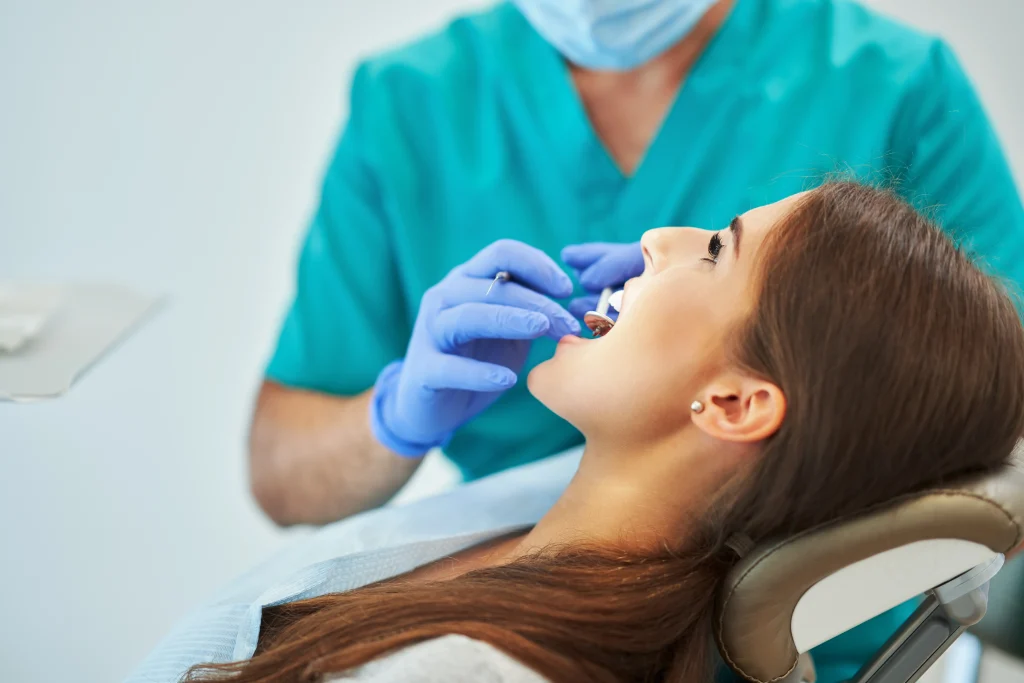
Dental implants are one of the most successful and longest-lasting solutions for replacing missing teeth. However, in patients who do not have enough bone in the posterior region of the upper jaw, a sinus lifting procedure may be needed before the implant can be placed. This procedure creates the bone volume required for the implant to be positioned safely and securely.
So what is sinus lifting, in which situations is it carried out, and what should patients expect afterwards? In this article, Frig Dent Dental Clinic in Eskişehir answers the questions patients ask most about sinus lifting.
What Is Sinus Lifting?
Sinus lifting is the controlled elevation of the floor of the maxillary sinus, located in the posterior part of the upper jaw, and the support of the resulting space with a bone graft.
After the upper molars are extracted, resorption of the jawbone can occur over time. During the same period, the sinus cavity may expand downwards, reducing the bone height available for an implant. In this situation, sinus lifting is carried out so that the implant can receive adequate support.
In short, the fundamental purpose of sinus lifting is to create sufficient bone height for implant treatment.
Why Is Sinus Lifting Done?
Not every implant patient needs a sinus lift. However, the procedure may be recommended in the following situations:
- Insufficient bone height in the posterior region of the upper jaw
- Tooth loss that occurred many years ago
- Bone resorption developing after tooth extraction
- Downward expansion of the maxillary sinus cavity
- A bone volume in which the implant could not be placed safely
During treatment planning, the amount of bone is assessed in detail using 3D dental tomography (CBCT), and our dentist determines whether a sinus lift is required.
How Is Sinus Lifting Performed?
Sinus lifting is carried out under local anaesthesia. The patient feels no pain during the procedure.
During surgery the gum tissue is carefully lifted and the sinus region is reached. After the sinus membrane has been elevated with special surgical instruments, the space created is filled with a bone graft. The area is then closed and the healing process begins.
If the amount of bone is suitable, the implant can be placed in the same session. Thanks to an experienced dentist, up-to-date technological instruments and fast implants, our clinic is able to carry out closed sinus lifting and rapid implant placement on the same day. Where bone deficiency is more pronounced, the graft is first left to integrate with the bone and the implant is placed a few months later.
The Difference Between Open and Closed Sinus Lifting
Sinus elevation can be carried out using two different techniques.
Open Sinus Lifting
This is preferred in patients with advanced bone loss. A small window is opened in the lateral wall of the sinus, the sinus membrane is elevated and a larger quantity of bone graft is applied.
Closed Sinus Lifting
This is used in cases where bone loss is less severe. It is a more minimally invasive method, carried out through the implant socket itself. The healing process is generally more comfortable.
Which method will be used is determined according to the patient’s bone structure.
The Healing Process After Sinus Lifting
Mild swelling, sensitivity and discomfort after the procedure are normal. In most patients these symptoms subside within a few days. For healthy healing, the following recommendations should be followed:
- Avoid hot and hard foods in the first few
- Do not blow your nose
- Keep your mouth open when
- Avoid strenuous exercise in the first few
- Do not smoke or drink
- Take the medication prescribed by your dentist
- Do not miss your follow-up
Full maturation of the bone graft generally takes between 4 and 9 months.
Is Sinus Lifting a Painful Procedure?
Because sinus lifting is carried out under local anaesthesia, no pain is felt during the operation. Any mild pain or sensitivity afterwards can be controlled with the prescribed painkillers. The majority of patients are able to return to their daily lives within a few days.
Is Sinus Lifting Safe?
Yes. When performed by an experienced oral and maxillofacial surgeon, sinus lifting is a very safe procedure with a high success rate.
As with any surgical procedure, complications such as infection, bleeding or a tear in the sinus membrane can occur. With correct planning and appropriate surgical technique, however, these risks are very low.
Implant Success After Sinus Lifting
Once sufficient bone has formed following a sinus lift, the success rate of the implant integrating with the jawbone is very high. To improve the success rate:
- Maintain regular oral
- Avoid
- Do not miss your dental check-
- Keep any chronic conditions under
With correctly planned treatment, implants can be used trouble-free for many years.
Frequently Asked Questions (FAQ):
How long does sinus lifting take?
The duration generally varies according to the technique used, but on average the procedure is completed in 30 to 60 minutes. Thanks to the up-to-date technological equipment at our clinic, closed sinus lifting can be carried out in just a few minutes.
When is the implant placed after a sinus lift?
If there is enough bone, the implant can be placed in the same session. In cases where bone is insufficient, a wait of 4–9 months is usually required.
Is there swelling after a sinus lift?
Mild swelling and oedema in the first few days are normal. Cold compresses and following your dentist’s recommendations make this period easier.
Can sinus lifting fail?
As with any surgical procedure there are small risks, but with correct patient selection, appropriate surgical technique and regular follow-up the success rate is very high.
Can sinus lifting be performed on everyone?
No. Additional assessment may be needed before the procedure in people with an active sinus infection or with certain systemic conditions. A detailed examination and radiological evaluation are therefore very important.
Sinus Lifting and Implant Treatment in Eskişehir | Frig Dent
To summarise, sinus lifting is a reliable surgical procedure that makes implant treatment possible in patients with insufficient bone in the upper jaw. With correct planning, an experienced dentist and regular check-ups, bone volume can be increased and the long-term success of implant treatment supported.
If you are planning to have an implant but are wondering whether you have enough bone in your upper jaw, you can contact Frig Dent Dental Clinic in Eskişehir so that we can create the most suitable treatment plan for you through a detailed clinical examination and three-dimensional imaging.