


SMART Amalgam Removal: What It Is and Why It Matters
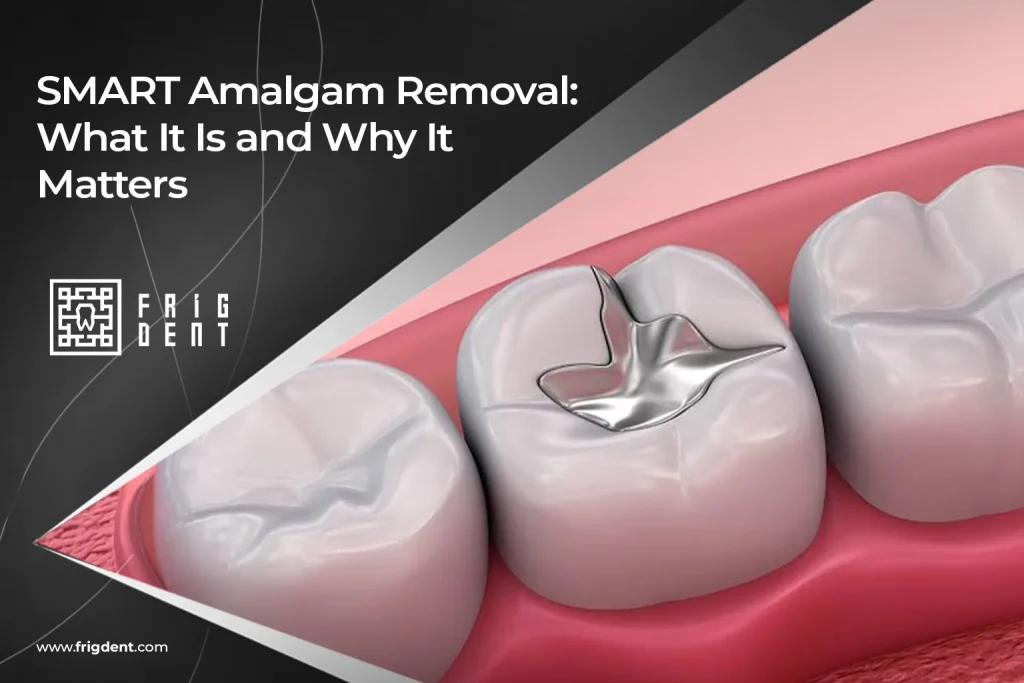
For decades, amalgam (silver-coloured) fillings were the standard choice for treating cavities, prized for their durability and low cost. Today, many patients are choosing to have these older fillings replaced — whether for cosmetic reasons, because the filling has aged and needs renewing, or out of a wish to reduce their exposure to mercury, which makes up roughly half of an amalgam filling’s content. Removing an amalgam filling incorrectly, however, can release mercury vapour and fine particles into the air and into the patient’s mouth. This is precisely the problem that the SMART protocol was designed to address.
What Does SMART Stand For?
SMART stands for Safe Mercury Amalgam Removal Technique. It is a set of precautions developed by the International Academy of Oral Medicine and Toxicology (IAOMT) to minimise a patient’s, and the dental team’s, exposure to mercury during the removal of amalgam fillings. Rather than simply drilling the old filling out, SMART treats the procedure as one requiring careful containment, much as any work involving a hazardous material would.
How Does the SMART Protocol Work?
A SMART-compliant removal follows a specific sequence of protective measures:
- Isolation of the tooth. A non-latex rubber (nitrile) dam is fitted tightly around the tooth being treated, sealing off the rest of the mouth and reducing the chance of fragments or vapour reaching the patient’s airway or being swallowed
- External air supply. The patient is given air or oxygen through a nasal mask, ensuring they are not breathing in the air immediately around the treatment site.
- High-volume air filtration and suction. A dedicated aerosol vacuum is positioned close to the tooth to capture mercury vapour and particles at the source, working alongside high-speed suction and, where possible, an open window or additional room ventilation.
- Sectioning, not grinding. Instead of drilling the amalgam into dust, the dentist sections the old filling into larger chunks using a carbide bur. Larger pieces release far less vapour and fine particulate than a fully pulverised filling.
- Copious water irrigation. Water is used continuously during the procedure to cool the site and flush away debris.
- Barrier protection. The patient’s skin, hair, and clothing are covered, and both dentist and staff wear respiratory-grade masks, face shields, and protective gowns.
- Charcoal or chlorella rinse. Patients are often given an activated charcoal or chlorella slurry to rinse with before and after the procedure, which can help absorb any trace mercury in the mouth.
- Amalgam separator. The clinic’s wastewater system captures amalgam waste before it can enter the water supply, in line with environmental best practice.
Is SMART Necessary for Everyone?
Amalgam fillings that are intact and causing no problems do not necessarily need to be removed. However, for patients who choose removal — for aesthetic reasons, due to a cracked or failing filling, or out of personal preference — the SMART protocol offers a far more cautious, controlled approach than conventional removal. It does not claim that amalgam fillings are dangerous to leave in place; rather, it addresses the specific risk that arises at the moment a filling is disturbed, drilled, or removed.
What to Expect at Frig Dent Dental Clinic
Patients considering amalgam replacement are welcome to discuss the SMART protocol with our dental team, who can explain each stage of the procedure, what protective measures will be used, and what alternative filling materials — such as composite resin — are available afterwards. As with any dental treatment, we recommend an individual consultation so that the approach can be tailored to your specific tooth, filling, and overall oral health.