


Personalized Laminate Veneer Treatment at Frig Dent
A beautiful smile can make a lasting impression. Discolored teeth, minor fractures, gaps, or irregular tooth shapes may affect your confidence when smiling. Laminate veneers, also known as porcelain veneers, offer a modern solution in aesthetic dentistry for patients who want to improve the appearance of their teeth while preserving as much natural tooth structure as possible.
At Frig Dent Oral and Dental Health Polyclinic in Eskişehir, Dt. Ayşegül Bardakcı provides personalized laminate veneer treatments designed around each patient’s facial features, oral structure, aesthetic expectations, and functional needs.
Using digital dentistry technologies and personalized smile design principles, the treatment process is carefully planned to create a natural-looking and harmonious smile.
What Are Laminate Veneers?
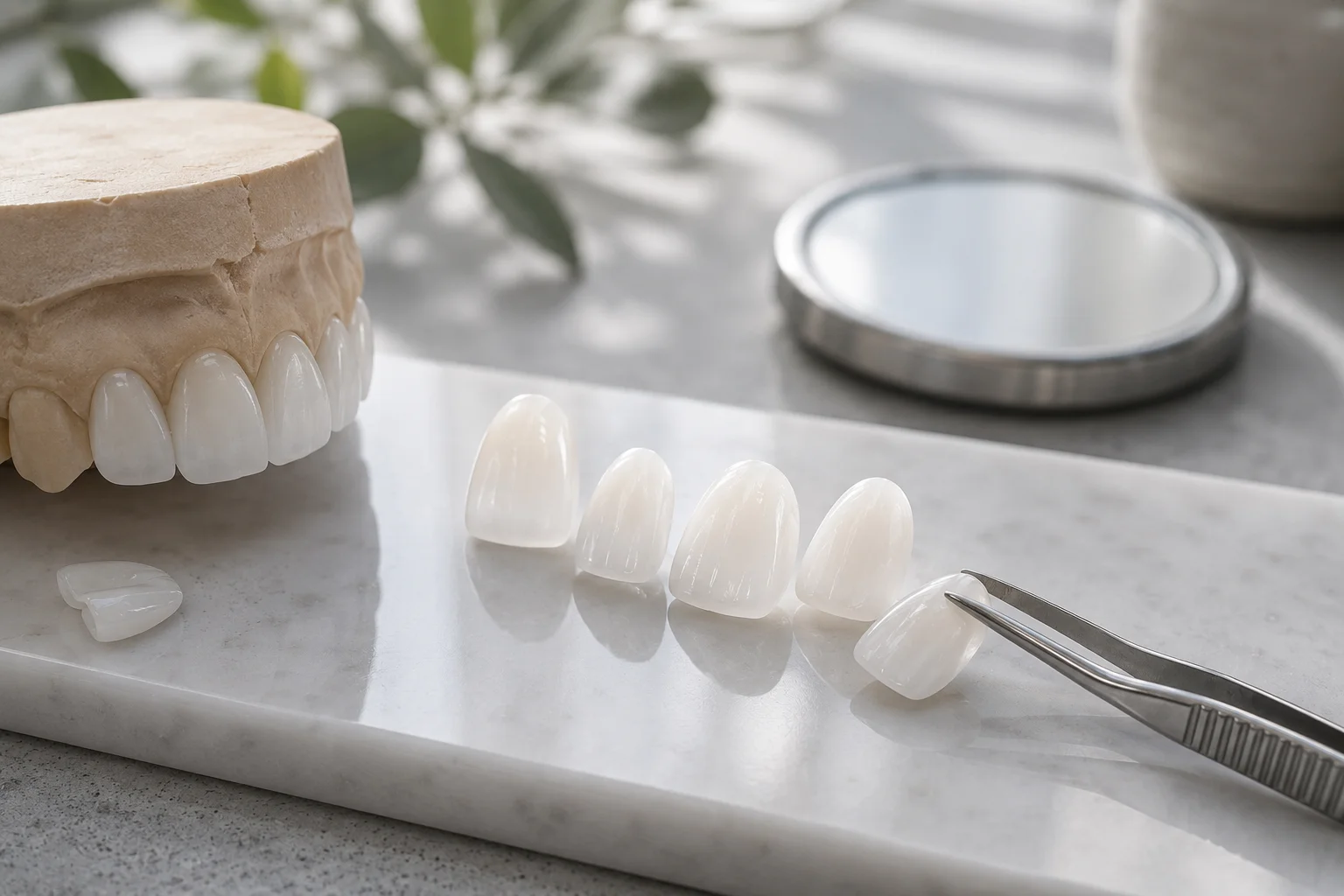
Laminate veneers are thin, custom-made ceramic restorations bonded to the front surfaces of the teeth. They are typically around 0.2–0.5 mm thick and are designed to provide an aesthetic appearance while preserving the natural tooth structure as much as possible.
Modern all-ceramic materials, including lithium disilicate-based materials such as E-max, offer excellent aesthetics, durability, and light transmission. Their optical properties can closely resemble natural tooth enamel, helping create a natural-looking smile.
Who Can Benefit from Laminate Veneers?
Laminate veneers may be an appropriate aesthetic dental treatment for patients who want to improve the appearance of their front teeth.
They may be considered for patients with:
- Discolored or stained front teeth,
- Teeth that have not achieved the desired result with whitening,
- Minor cracks or fractures,
- Gaps between the front teeth (diastema),
- Irregular or disproportionate tooth shapes,
- Old or unaesthetic fillings,
- A desire for a more symmetrical and aesthetically pleasing smile.
However, laminate veneers are not suitable for everyone. Patients with severe bruxism (teeth grinding), active gum disease, significant tooth crowding, extensive tooth structure loss, or insufficient enamel may require alternative or preliminary treatments.
A detailed clinical examination is essential before deciding whether laminate veneers are the right treatment option.
How Does Laminate Veneer Treatment Work?
At Frig Dent, each laminate veneer treatment is planned according to the patient’s individual needs and aesthetic goals.
1. Comprehensive Dental Examination and Digital Planning
The first step is a detailed evaluation of your teeth, gums, bite, and overall oral health. Digital intraoral scanning technology may be used to create highly accurate digital impressions without traditional impression materials.
Digital planning can improve patient comfort and help the dental team design precise, personalized restorations.
2. Personalized Smile Design
A successful smile is about more than simply having white teeth. During smile design, several factors are considered together, including:
- Facial proportions,
- Facial symmetry,
- Lip structure and support,
- Smile line,
- Gum line,
- Tooth length and proportions,
- Midline,
- Overall facial aesthetics.
At Frig Dent, Dt. Ayşegül Bardakcı uses a personalized approach to plan a smile that complements each patient’s unique facial characteristics rather than applying the same design to everyone.
3. Minimal Tooth Preparation
One of the key advantages of laminate veneers is the potential to preserve a significant amount of natural tooth structure.
Depending on the individual case, only minimal enamel preparation may be required. In selected suitable cases, no-prep or minimal-prep laminate veneers may also be considered.
The amount of tooth preparation depends on factors such as tooth position, bite relationship, enamel structure, and the desired aesthetic result.
4. High-Precision Laboratory Fabrication
Following digital planning and impressions, custom-made all-ceramic laminate veneers are fabricated with high precision to achieve the desired shape, size, color, and aesthetic harmony.
5. Permanent Bonding
Once the veneers have been carefully evaluated and approved, they are bonded to the tooth surfaces using specialized adhesive systems.
With proper treatment planning, appropriate case selection, and good oral care, laminate veneers can provide long-lasting aesthetic results.
Laminate Veneers vs. Zirconium Crowns: Which Is Better?
One of the most common questions in aesthetic dentistry is whether laminate veneers or zirconium crowns are the better option.
The answer depends on the condition of your teeth and your individual treatment needs.
Laminate Veneers
Laminate veneers may be preferred when:
- The natural tooth structure is largely healthy,
- Minimal tooth preparation is desired,
- Anterior teeth require aesthetic improvement,
- High light transmission and a natural appearance are important,
- The goal is to preserve healthy tooth structure.
Zirconium Crowns
Zirconium crowns may be more appropriate in cases involving:
- Significant loss of tooth structure,
- Teeth requiring extensive restoration,
- Certain cases where bridges are planned.
The most suitable treatment cannot be determined solely from photographs. A comprehensive clinical examination is necessary to evaluate your teeth and recommend the appropriate option.
Benefits of Laminate Veneers
When appropriately planned and applied, laminate veneers can offer several aesthetic and functional benefits:
- Natural-looking tooth appearance,
- High light transmission,
- Excellent color stability,
- Resistance to staining from tea, coffee, and smoking,
- Use of biocompatible ceramic materials,
- Good compatibility with the gums,
- Preservation of natural tooth structure,
- Long-lasting aesthetic results.
How Long Do Laminate Veneers Last?
With appropriate case selection, correct bonding techniques, good oral hygiene, and regular dental check-ups, laminate restorations may remain successful for 10–15 years or even longer.
The lifespan of laminate veneers can vary depending on several individual factors, including:
- Oral hygiene,
- Teeth grinding and clenching habits,
- Dietary habits,
- Oral care routine,
- Regular dental examinations.
Following your dentist’s recommendations can help protect your veneers and maintain their appearance over time.
How to Care for Your Laminate Veneers
Proper oral hygiene and regular dental care are important for maintaining your veneers.
After laminate veneer treatment, you should:
- Brush your teeth at least twice a day,
- Use dental floss or interdental brushes,
- Avoid biting or breaking very hard foods with your front teeth,
- Avoid habits such as biting pens or other hard objects,
- Attend regular dental check-ups,
- Consider a night guard if you have a teeth-grinding problem and your dentist recommends one.
Is Laminate Veneer Treatment Painful?
Laminate veneer treatment is generally considered a comfortable dental procedure. Local anesthesia may be used when necessary, and minimal tooth preparation can help make the treatment process more comfortable.
Your dentist will evaluate your individual situation and explain what to expect during each stage of treatment.
Do Laminate Veneers Look Natural?
Yes. When properly planned and fabricated, laminate veneers can achieve a highly natural appearance.
Modern all-ceramic materials have optical properties that can closely resemble natural tooth enamel. Factors such as tooth color, shape, length, translucency, gum aesthetics, facial proportions, and lip support are considered during personalized smile design.
The goal of aesthetic dentistry is not simply to create extremely white teeth, but to create a smile that looks natural and harmonious with the patient’s face.
Do Laminate Veneers Turn Yellow?
High-quality ceramic materials offer excellent color stability and are resistant to discoloration. However, maintaining good oral hygiene and attending regular dental check-ups remain important for overall oral health and the long-term appearance of your smile.
Can Laminate Veneers Break?
Laminate veneers are durable restorations designed for everyday use. However, like natural teeth and other dental restorations, they can be damaged by excessive force, trauma, or improper use.
Avoiding habits such as biting hard objects and following your dentist’s recommendations can help protect your veneers.
Are Laminate Veneers Suitable for Everyone?
No. Laminate veneers are not suitable for every patient.
Patients with severe bruxism, active gum disease, significant crowding, extensive loss of tooth structure, or insufficient enamel may require alternative treatments or preliminary dental procedures.
For this reason, a personalized clinical examination and treatment planning are essential before proceeding with laminate veneers.