


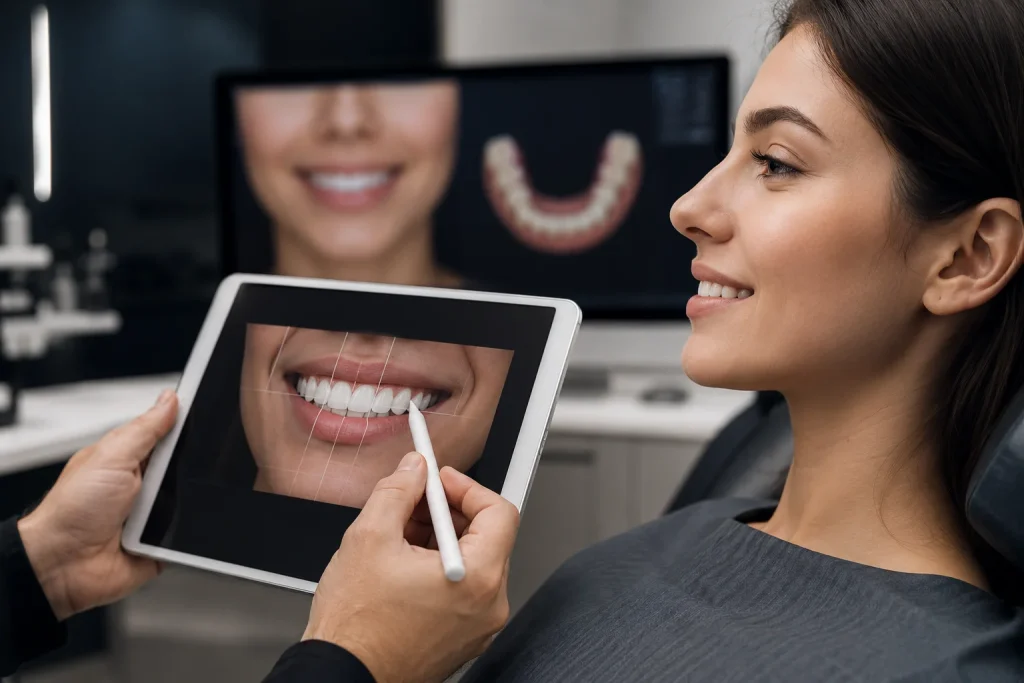
What makes a smile beautiful is not just white, straight teeth.
A genuinely natural-looking smile emerges when the proportion of the teeth to the face, the movement of the lips, the appearance of the gums, the length of the teeth, the smile line and the person’s overall facial character all come together.
So can all of these details be analysed digitally before a new smile is designed? Yes.
Digital Smile Design (DSD), used in aesthetic dentistry today, is a modern planning approach that focuses not only on how the teeth look inside the mouth, but on how they integrate with the face.
DSD’s own official sources also state that the method is not merely a computer application; it is a comprehensive methodology that changes how dentists approach aesthetic treatment planning, patient communication and digital workflows. (Digital Smile Design)
At Frig Dent Oral and Dental Health Clinic, Dr Ayşegül Bardakcı incorporates the digital smile design approach into aesthetic treatment planning, drawing on her Digital Smile Design training and her DSD certification.
In this article we look in detail at the questions: what is Digital Smile Design, how is it done, who is it suitable for, which treatments can be planned with DSD, and why is DSD different from classic smile design?
What Is Digital Smile Design (DSD)?
Digital Smile Design is an approach that aims to make treatment planning in aesthetic dentistry more systematic, more visual and more personalised.
While classic smile design assesses the colour, shape and alignment of the teeth, digital smile design can also take into account the overall structure of the face and the dynamics that occur during smiling.
For example, a person’s teeth may look aesthetically flawless on their own. But if the length of the teeth is not in harmony with the facial proportions, the result may not look natural.
For that reason, the fundamental question in modern smile design should not be: “How beautiful are the teeth?” but “How well do these teeth suit this face?”
DSD’s educational content also emphasises that aesthetic results should be assessed not by looking at the teeth alone, but through integration with the face, natural forms and the correct relationship between colour and value. (Digital Smile Design)
Is DSD Just a Computer Program?
No.
This point is particularly important.
Online, “having DSD done” is sometimes understood as simply altering the teeth on a photograph on a computer. Yet according to Digital Smile Design’s official description, DSD is not just an application. Although digital tools are part of the system, its real value comes from treatment planning and clinical approach being handled through a defined methodology. (Digital Smile Design)
In other words, drawing an attractive tooth on a computer does not by itself amount to DSD. The design that is prepared must:
- Be in harmony with the face,
- Integrate with lip movement,
- Work well with the gums,
- Be assessed in terms of function,
- Be clinically applicable,
- Match the restorations that will be
Digital smile design should therefore be seen as a planning process in which technology and clinical experience are used together.
How Is Digital Smile Design Done?
In digital smile design, treatment planning can begin by collecting a range of digital data from the patient.
These may include:
- Facial photographs,
- Smile photographs,
- Intraoral images,
- Digital intraoral scans,
- The current condition of the teeth,
- The appearance of the gums,
- The smile line,
- Lip movements,
- Any necessary radiographic
When this data is assessed together, the position and proportions of the teeth within the face can be analysed far more comprehensively.
DSD’s own materials likewise explain that assessing different facial views alongside digital data supports treatment planning. (Digital Smile Design)
Why Does the Face Matter So Much in Smile Design?
Because the teeth are not a structure independent of the face. When you smile:
lips + teeth + gums + facial proportions are all visible at the same time.
For example, very long front teeth may create a youthful, dynamic look on some faces, while on another face they may look out of proportion. The same applies to the width and colour of the teeth.
For this reason, rather than applying one standard tooth form to everyone, personalised smile design should assess together the person’s:
- Face shape,
- Lip structure,
- Age,
- Gum level,
- Existing dental structure,
- Smile line,
- Personal aesthetic
Why Does “Naturalness” Matter in Digital Smile Design?
One of the most common problems encountered in aesthetic dentistry is teeth that look overly artificial.
Teeth that are very white, all exactly the same size and look like copies of one another do not always create a natural smile.
Natural teeth have small differences in form, light transmission, surface texture and gradations of colour.
The goal of a successful smile design is therefore not merely:
“making the teeth whiter”.
The real aim is to achieve a result that is:
natural + balanced + in harmony with the face + functional.
DSD’s educational approach likewise treats integration with the face and natural forms as among the fundamental elements of an aesthetic smile. (Digital Smile Design)
Which Treatments Can Be Planned with DSD?
Digital smile design is not a treatment in itself. It can help in planning a range of aesthetic and restorative treatments.
Laminate Veneers
When planning laminate or leaf porcelain veneers, the length, width, midline and smile line of the teeth can be assessed digitally.
This makes it possible to aim for restorations that are more in harmony with the face.
Zirconia and Ceramic Restorations
The form and aesthetic proportions of the teeth can also be taken into account when planning zirconia or other ceramic restorations.
Teeth Whitening
As part of the smile design, the current tooth colour can be assessed and the target aesthetic appearance planned accordingly.
Gum Aesthetics
Irregularities in gum levels or excessive gum display can form part of the aesthetic plan.
Aesthetic Restorations on Implants
In implant treatment in the anterior region in particular, it is important to consider in advance not only the placement of the implant but also the final appearance of the tooth that will sit on top of it.
In cases where implant treatment and smile design are planned together, a digital approach can therefore offer a significant planning advantage.
One of DSD’s Biggest Advantages: Patient–Dentist Communication
In smile design, what the patient expects matters just as much as what the dentist has in mind. One patient may say:
“I’d like my teeth to look a bit more natural.” Another may say:
“I want a more striking, youthful smile.”
But it is not always easy to understand exactly what these statements mean clinically through verbal communication alone.
Digital design can help make this communication visual.
DSD sources note that digital tools can help patients better understand possible outcomes, clarify expectations and allow the treatment plan to be shared more clearly. (Digital Smile Design)
Digital smile design can therefore be seen not only as aesthetic planning, but also as a tool that strengthens communication between patient and dentist.
What Is a Mock-Up? Can You See Your Smile Design in Advance?
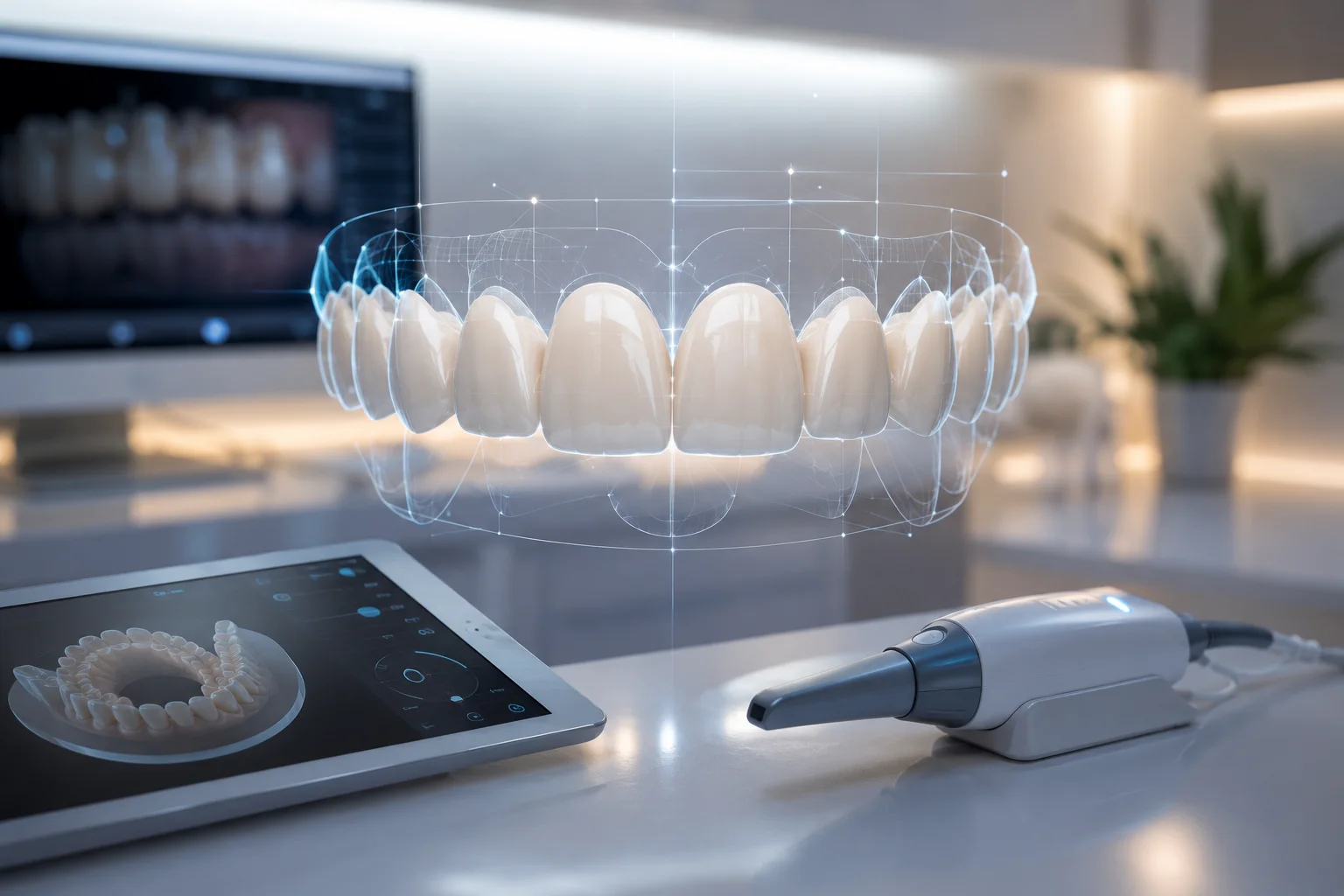
One of the important stages used in smile design is the mock-up — trying the planned design temporarily in the mouth.
This allows the patient to get a much more concrete idea of how the planned tooth form looks on their own face.
DSD’s official sources describe the Motivational Mock-up as an important stage that allows the patient to see and experience the planned smile. (Digital Smile Design)
This stage is particularly important for assessing expectations before treatment begins.
Does Digital Smile Design Give Everyone the Same Smile?
No.
On the contrary, one of DSD’s core aims is a personalised smile design.
Because no two people have the same facial structure, the ideal smile design for two people would not be expected to be identical either.
Softer, rounder forms may be preferred for one patient, while more defined, characterful tooth forms may be appropriate for another.
For that reason, a successful smile design should create a design suited to the person’s own facial features, rather than a one-size-fits-all “Hollywood Smile” approach.
Dr Ayşegül Bardakcı and Digital Smile Design
At Frig Dent Oral and Dental Health Clinic, Dr Ayşegül Bardakcı — alongside her work in aesthetic dentistry — has completed Digital Smile Design training and, as a dentist holding DSD certification, incorporates the digital smile design approach into her treatment planning.
It is worth underlining here that DSD training is not simply a matter of learning a program.
According to DSD’s official training descriptions, the DSD Provider approach covers not only smile design but also treatment planning, communication, digital workflows and the different stages of a comprehensive approach to dentistry. (Digital Smile Design)
This approach is applied alongside Frig Dent’s understanding of digital dentistry, aesthetic dentistry and personalised treatment planning.
Who Is Digital Smile Design Suitable For?
Digital smile design can be particularly useful for patients who want to improve their appearance and who want to see the planning in more detail before treatment.
For example, digital planning may be considered for:
- People who are unhappy with the shape of their teeth,
- Those who want to change the colour of their teeth,
- People with chips or wear on their front teeth,
- Those with gaps between their teeth,
- People who are bothered by the appearance of their gums,
- Those considering laminate veneers,
- Patients for whom ceramic or zirconia restorations are planned,
- Anyone who wants a smile makeover,
- Patients for whom aesthetic restorations are planned after an
However, which method will be used should be determined after the person’s oral and dental structure has been assessed.
What Is the Difference Between DSD and Classic Smile Design?
Classic smile design can also assess the aesthetic characteristics of the teeth and their harmony with the face.
What sets DSD apart is that it supports this process with digital data, systematic analysis, visual communication and a defined methodology.
The scientific literature has likewise shown that digital smile design systems can help assess various parameters relating to facial, gingival and dental aesthetics, and that digital technologies can be used in aesthetic treatment planning. (Digital Smile Design)
It should not be forgotten, though, that digital systems do not replace the dentist’s judgement. Technology does not make the decision; it helps the right clinical decision to be better planned.
Frequently Asked Questions (FAQ):
What is Digital Smile Design (DSD)?
DSD is a methodology that helps aesthetic dental treatments to be planned more systematically, using digital technologies and a face-focused planning approach.
Is DSD an application?
No. According to DSD’s official description, Digital Smile Design is not just an application; it is a broader approach that also encompasses treatment planning, patient communication and digital workflows. (Digital Smile Design)
Can the smile design be seen in advance with DSD?
With digital simulation and, in suitable cases, methods such as a mock-up, it may be possible to assess the planned smile visually.
Is DSD only used for laminate veneers?
No. Digital smile design can also be used in planning laminate, ceramic and zirconia restorations, gum aesthetics and aesthetic restorations on implants.
Does DSD design the same teeth for everyone?
No. The aim is to create a design in harmony with the person’s facial structure, smile line, lips, gums and personal expectations.
Does DSD guarantee the result of treatment?
No. No digital system guarantees a treatment outcome absolutely. DSD is a method that supports sound clinical assessment and treatment planning.
Conclusion: A Beautiful Smile Is Not Made of Teeth Alone
Digital Smile Design (DSD) is an approach that allows technology to be used in aesthetic dentistry not just to create an image, but to make treatment planning more systematic and more personalised.
Rather than focusing solely on the colour or shape of the teeth, smile design should assess as a whole:
face + lips + teeth + gums + function + personal expectations.
At Frig Dent Oral and Dental Health Clinic, Dr Ayşegül Bardakcı integrates the digital smile design approach into aesthetic dental practice through her Digital Smile Design training and DSD certification.
The aim is not to create the same “perfect” smile for everyone, but to design a natural, balanced and personalised smile that looks as though it belongs to that person’s own face.
Sources and References
This content was prepared drawing on Digital Smile Design’s official sources and on published academic literature on digital smile design. DSD’s official sources define DSD not merely as an application, but as a methodology encompassing smile design, treatment planning, communication and digital workflows. (Digital Smile Design)