


PRF in Dentistry: Healing Faster with Your Own Blood
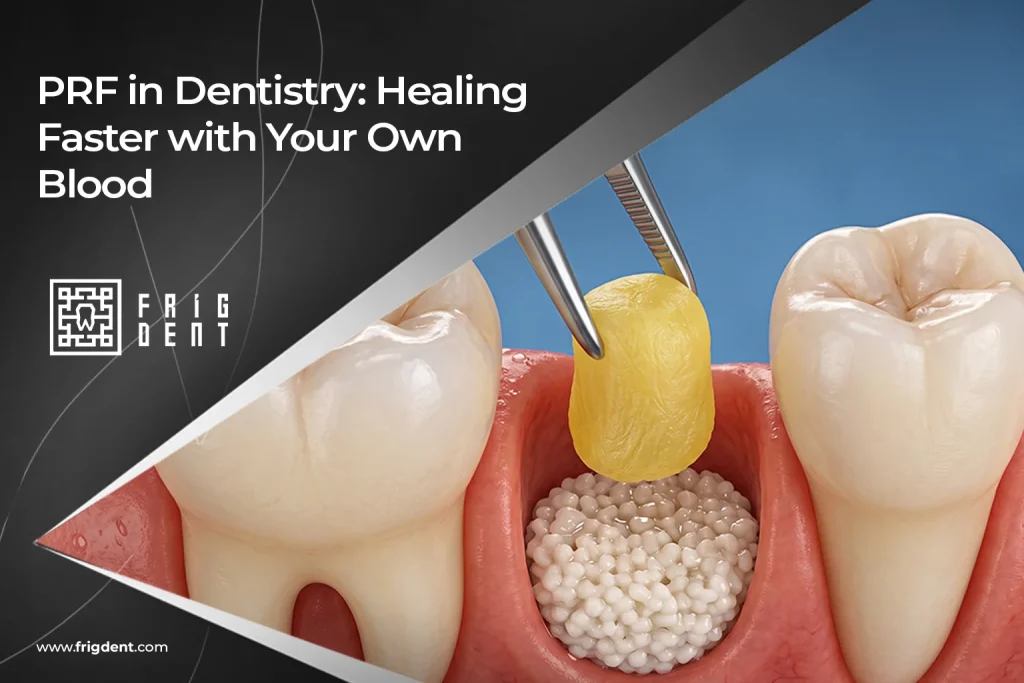
Modern dentistry increasingly draws on the body’s own healing resources rather than relying solely on external materials. Where treatment once meant choosing between a synthetic membrane, a donor graft, or simply waiting for tissue to heal on its own, an entire category of “biologic” techniques has grown up around the idea that a patient’s own blood already contains what is needed to accelerate repair. One of the clearest examples is PRF — Platelet-Rich Fibrin — a technique that has become a standard part of many implant, extraction, and gum grafting procedures because it speeds up healing and lowers the risk of complications, using nothing more than a small sample of the patient’s own blood.
What Is PRF?
PRF is a concentrate prepared from the patient’s own blood, rich in platelets, white blood cells, and growth factors — the same cells and signalling proteins the body naturally sends to a wound to begin repair. When a small blood sample is processed correctly, its platelets become trapped within a dense fibrin network and begin releasing growth factors such as PDGF, TGF-β, and VEGF over several days, rather than all at once. This slow, sustained release is what makes PRF particularly effective at supporting new blood vessel formation, collagen production, and bone regeneration. PRF was developed in France in the early 2000s by Dr Joseph Choukroun as a refinement of the earlier PRP (Platelet-Rich Plasma) technique. Unlike PRP, PRF is prepared without anticoagulants or other additives, allowing the blood to clot naturally into a dense, stable fibrin matrix — a natural scaffold packed with healing factors that can be handled, shaped, and placed directly into a surgical site as a small membrane or plug. The technique has since been refined further, and clinics today may prepare several forms depending on the clinical goal, including a liquid form known as injectable PRF, or i-PRF, which can be mixed with bone graft material or injected into soft tissue.
How Is PRF Prepared?
The process takes place entirely in the clinic, during the same appointment as the surgical procedure, with no separate visit required:
- A small sample of the patient’s blood is drawn, much like a routine blood test.
- The sample is placed in a specialised centrifuge, which spins it at a controlled speed to separate its components without damaging the platelets.
- Within roughly ten to fifteen minutes, the red blood cells settle at the bottom while the platelet- and fibrin-rich layer forms in the middle — this is the PRF, ready to use immediately.
- Depending on the clinical need, the resulting fibrin clot can be used as a soft, flexible membrane to cover a surgical site, compressed into a firmer matrix, or mixed with bone graft material to create what is sometimes called “sticky bone.”
Because it comes from the patient’s own blood, there is no risk of allergic reaction, immüne rejection, or disease transmission, and no need for synthetic additives or donor tissue of any kind. The entire preparation happens chair-side using standard, sterile laboratory equipment, and the resulting material is used within minutes of being drawn, while it is still biologically active.
Where Is PRF Used in Dentistry?
- Tooth extractions. PRF placed directly into the empty socket protects it from infection, reduces post-extraction discomfort and dry socket risk, and encourages faster soft tissue and bone healing.
- Dental implants. PRF can be placed around and beneath an implant to support the surrounding bone and soft tissue during the healing period, often contributing to more predictable long-term implant stability.
- Sinus lift procedures. When combined with bone grafting material in the upper jaw, PRF has been shown to support faster, more predictable bone regeneration before implant placement.
- Gum (periodontal) treatments. As a membrane, PRF can cover exposed roots or grafted tissue, protecting the site while it heals and supporting gum regeneration and thicker, healthier tissue.
- Bone and soft-tissue defects. PRF is increasingly used to support healing around areas of bone loss or thin gum tissue, including sites being prepared for future implant placement.
How Does PRF Compare to PRP?
PRF offers several practical advantages over the older PRP technique it evolved from. With no anticoagulant, the fibrin network that forms is denser and more stable, allowing growth factors to release gradually over several days rather than in a single early burst — a slower release that better matches the natural timeline of tissue healing. Preparation is also simpler, requiring only a single centrifugation step and no chemical activators, which keeps chair-side time short and cost low. Because PRP relies on added anticoagulants and often a separate activation step, its growth factor release tends to peak early and taper off quickly, whereas PRF’s fibrin scaffold continues to release healing factors for around a week, aligning more closely with the body’s own repair schedule.
What Does Recovery Look Like?
Patients generally notice no additional discomfort from the PRF portion of a procedure itself, since it uses tissue the body already produces. Many patients report less swelling and a more comfortable healing period at sites where PRF has been used compared with similar procedures performed without it, and clinical experience suggests a lower rate of complications such as dry socket after extractions. As with any surgical procedure, following your dentist’s aftercare instructions — including diet, oral hygiene, and any prescribed medication — remains the most important factor in a smooth recovery.
Is PRF Right for You?
PRF is not a treatment on its own — it is a supportive technique used alongside procedures such as extractions, implant placement, sinus lifts, or gum grafting to make healing smoother and more predictable. Because it is prepared from a small blood sample in a matter of minutes, it adds very little time or complexity to a procedure while offering a meaningful advantage during recovery. Most patients are suitable candidates, though your dentist will review your general health and any blood-related conditions during your consultation to confirm it is appropriate for your specific treatment plan.
What to Expect at Frig Dent Dental Clinic
If you are having a tooth extracted, an implant placed, or gum treatment planned, our dental team can explain whether PRF is a suitable addition to your procedure and what the preparation and application process will involve. The blood draw itself takes only a minute or two and feels no different from a routine test at any medical clinic. As always, we recommend an individual consultation so your treatment plan can be tailored to your specific needs and so any questions about the technique can be answered before your appointment.