


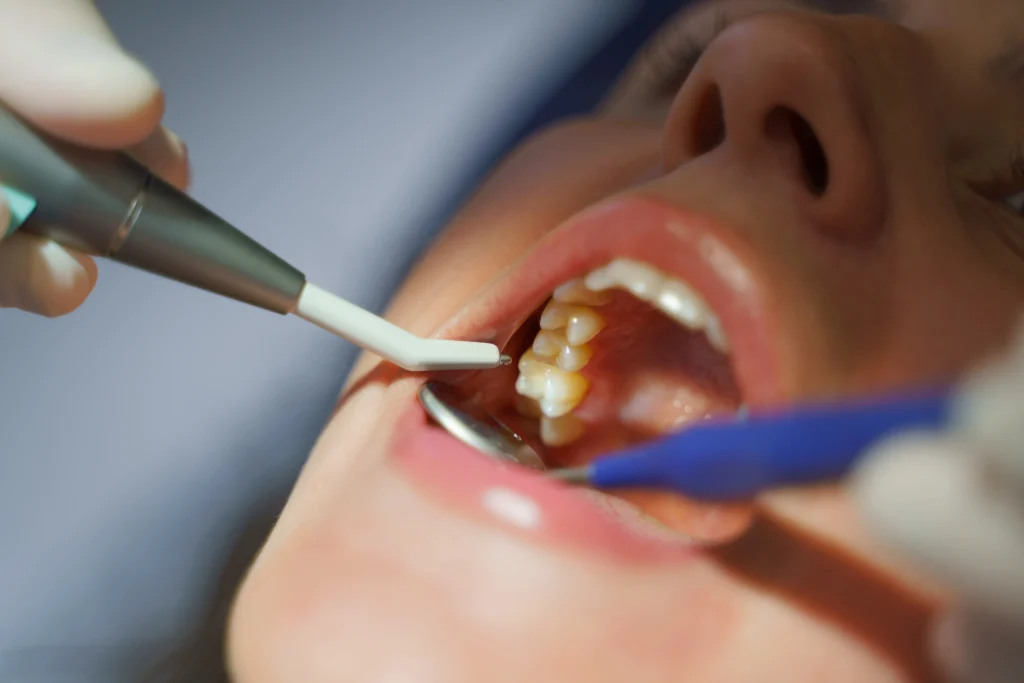
When people hear “scaling”, most picture the same scene: a metal instrument, a long scraping noise and sensitive gums afterwards. In modern dentistry, however, professional cleaning has become a completely different experience.
With today’s AIRFLOW technology, teeth are cleaned using a controlled mixture of air, warm water and an ultra-fine powder. No metal touches the tooth surface, the procedure is far more comfortable, and — most importantly — not every patient receives the same powder at the same setting.
In this article, Frig Dent Dental Clinic in Eskişehir explains how tartar forms, how the AIRFLOW device works, which powder suits which patient, and how the GBT (Guided Biofilm Therapy) protocol differs from conventional cleaning.
What Is Tartar and How Does It Form?
A sticky, almost invisible layer of bacteria called biofilm forms continuously in the mouth. This is what most people call plaque.
When this layer is not removed regularly, minerals from the saliva precipitate into it and it gradually hardens. This hardened deposit is tartar (calculus).
The key characteristic of tartar is this: once it has formed, it cannot be removed by brushing, by mouthwash or by any home care product. It can only be removed professionally, in the clinic.
Left in place, it can lead to:
- Bleeding and inflamed gums
- Gum recession
- Bad breath
- Bone loss
- Tooth loss at an advanced stage
The Real Target Is Biofilm, Not Tartar
This is where the modern approach differs most.
Conventional cleaning focuses on scraping away the hard deposit — the tartar. But the true cause of gum disease and decay is not the tartar itself; it is the biofilm that creates it.
For this reason, the current protocol first makes biofilm visible and removes it completely, then targets whatever hard calculus remains. Soft layer first, hard deposit second.
The sequence sounds simple, but it changes the result: once the biofilm has been cleared, exactly where the calculus remains becomes visible, so there is no need to run an instrument across every surface in the mouth.
What Is GBT? The Eight-Step Protocol
Guided Biofilm Therapy (GBT), developed by the Swiss company EMS, is a systematic professional cleaning protocol consisting of eight steps:
- Assess — the teeth, gums and implants are examined and pocket depths measured
- Disclose — a special solution stains the biofilm and makes it visible
- Motivate — patients are shown the deposits in their own mouth and given personalised brushing advice
- AIRFLOW — air, warm water and fine powder remove biofilm, stains and early calculus
- PERIOFLOW — a slim, flexible nozzle reaches into deeper periodontal pockets
- PIEZON — any remaining hard calculus is removed ultrasonically
- Check — a final control confirms no biofilm or calculus remains; fluoride is applied if needed
- Recall — the next appointment is scheduled according to the person’s individual risk level
The eighth step matters more than it appears. The right interval is not six months for everyone. For someone who smokes, has a history of gum disease or has implants, the interval may need to be shorter.
The Disclosing Stage: You Can’t Clean What You Can’t See
Biofilm is almost colourless, which makes it invisible to both patient and dentist. A disclosing solution stains this layer so that:
- The clinician sees exactly where cleaning is needed
- The patient sees which areas their own brushing consistently misses
Many people say the same thing at this stage: “I brush every day, but I’ve clearly never touched this area.” Disclosing is therefore not just a cleaning step — it is an awareness step.
Powder and Water: How Does the AIRFLOW Device Work?
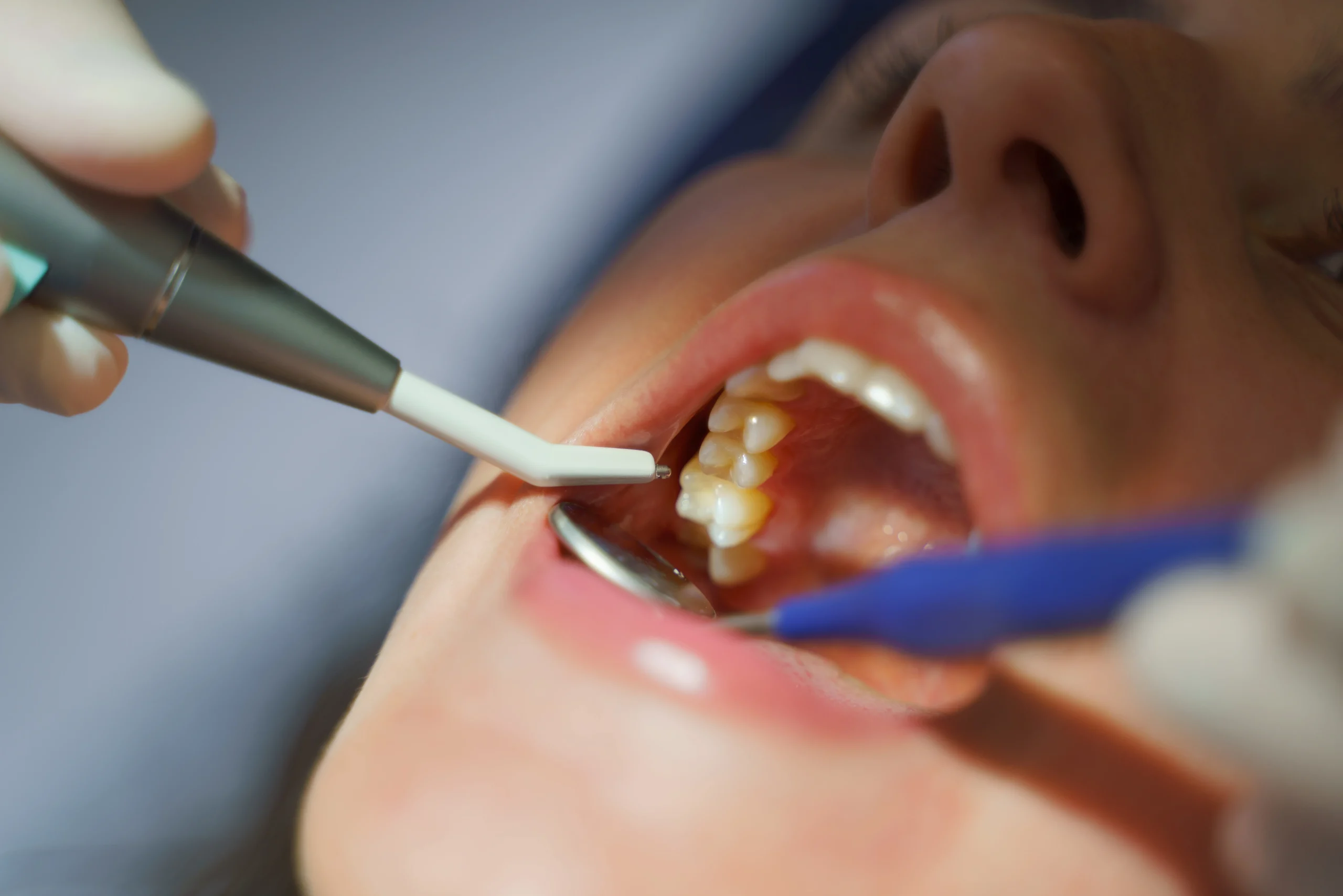
The AIRFLOW device sprays a mixture of pressurised air, warm water and very fine powder onto the tooth surface. The nozzle does not touch the tooth; the mixture does the cleaning.
The water being warm sounds like a minor detail, but it noticeably improves comfort in sensitive teeth.
Because there is no metal contact:
- The enamel surface is not scratched
- Composite fillings, porcelain and zirconia surfaces are protected
- Implant surfaces can be cleaned safely
- The area around orthodontic brackets can be cleaned easily
Fine Powder or Classic Powder? A Personalised Choice
The most interesting feature of AIRFLOW is that it does not use a single powder. Different powders are selected according to need — and this is what genuinely makes the experience personal.
Fine powder (erythritol-based)
With a particle size of around 14 microns, this is extremely gentle and is the standard choice for routine cleaning. It can also be used safely below the gum line, to a depth of roughly 4 mm. Erythritol is also a sweet compound, which makes the procedure more pleasant for the patient.
Classic powder (sodium bicarbonate-based)
This has a larger particle size, around 40 microns. It is more effective on heavy tea, coffee and tobacco staining. Typically, heavy stains are removed first with the classic powder, and the fine powder is then used for sensitive areas and along the gum margin.
Perio powder (glycine-based)
With a particle size of around 25 microns, this powder is particularly gentle on soft tissue. It is preferred in sensitive areas such as periodontal pockets and around implants.
In other words, the same device can be used at different settings from region to region — even within the same mouth. Using two different powders for a patient with tobacco staining on the front teeth and gum sensitivity at the back is entirely routine.
PERIOFLOW: Cleaning Periodontal Pockets
Where there is gum recession or periodontal disease, the problem is not confined to the tooth surface. Biofilm also accumulates inside the pocket that forms between gum and tooth.
Thanks to its slim, flexible design, the PERIOFLOW nozzle reaches into these pockets and can clean biofilm at depths of up to 9 mm. It is far less traumatic than conventional curettage and preserves the root surface.
Is It Painful, and How Long Does It Take?
For most patients, AIRFLOW treatment is painless. Because there is no metal scraping sensation, the difference is especially noticeable for people who have found scaling uncomfortable in the past.
The duration depends on how much deposit is present, but it is usually between 30 and 45 minutes. It may take longer where there is heavy calculus or deep pockets to clean.
Frequently Asked Questions (FAQ):
Does scaling wear the teeth down?
No. When performed with the correct technique, no enamel is lost. With AIRFLOW there is no metal contact at all — the powder and water mixture does the cleaning.
Gaps appeared between my teeth after cleaning. Why?
This is not a side effect. The tartar had already pushed the gum aside and created that space; removing it simply reveals the situation underneath. Cleaning does not open the gap — it makes it visible.
How often should I have it done?
Every 6 months on average. However, the interval may be shorter if you smoke, have a history of gum disease, or have implants or orthodontic appliances. The right frequency is individual.
I have implants or veneers – can it still be used?
Yes. AIRFLOW is far gentler on restoration and implant surfaces than metal instruments. Regular maintenance around implants is important in preventing peri-implantitis.
Will my teeth become whiter?
AIRFLOW is not a whitening procedure. However, because it removes surface stains from tea, coffee and tobacco, the teeth return to their natural shade — and most people notice a clear difference in freshness and brightness.
What should I pay attention to afterwards?
Limiting strongly coloured drinks for the first few hours is generally enough. If fluoride has been applied, your dentist may ask you to wait before eating or drinking.
Dental Scaling in Eskişehir | Frig Dent
Scaling is one of those procedures where postponing costs the most. A problem that can be resolved early in a comfortable 30–45 minute session can, if neglected, progress as far as gum surgery or bone loss.
At Frig Dent Dental Clinic in Eskişehir, we approach professional cleaning as a biofilm-focused, personalised procedure: we make the deposits visible first, clean with the powder appropriate to your needs, and only then target the remaining calculus.
If you notice bleeding gums, sensitivity or a build-up of tartar, contact Frig Dent Dental Clinic for a detailed examination and a personalised care plan.